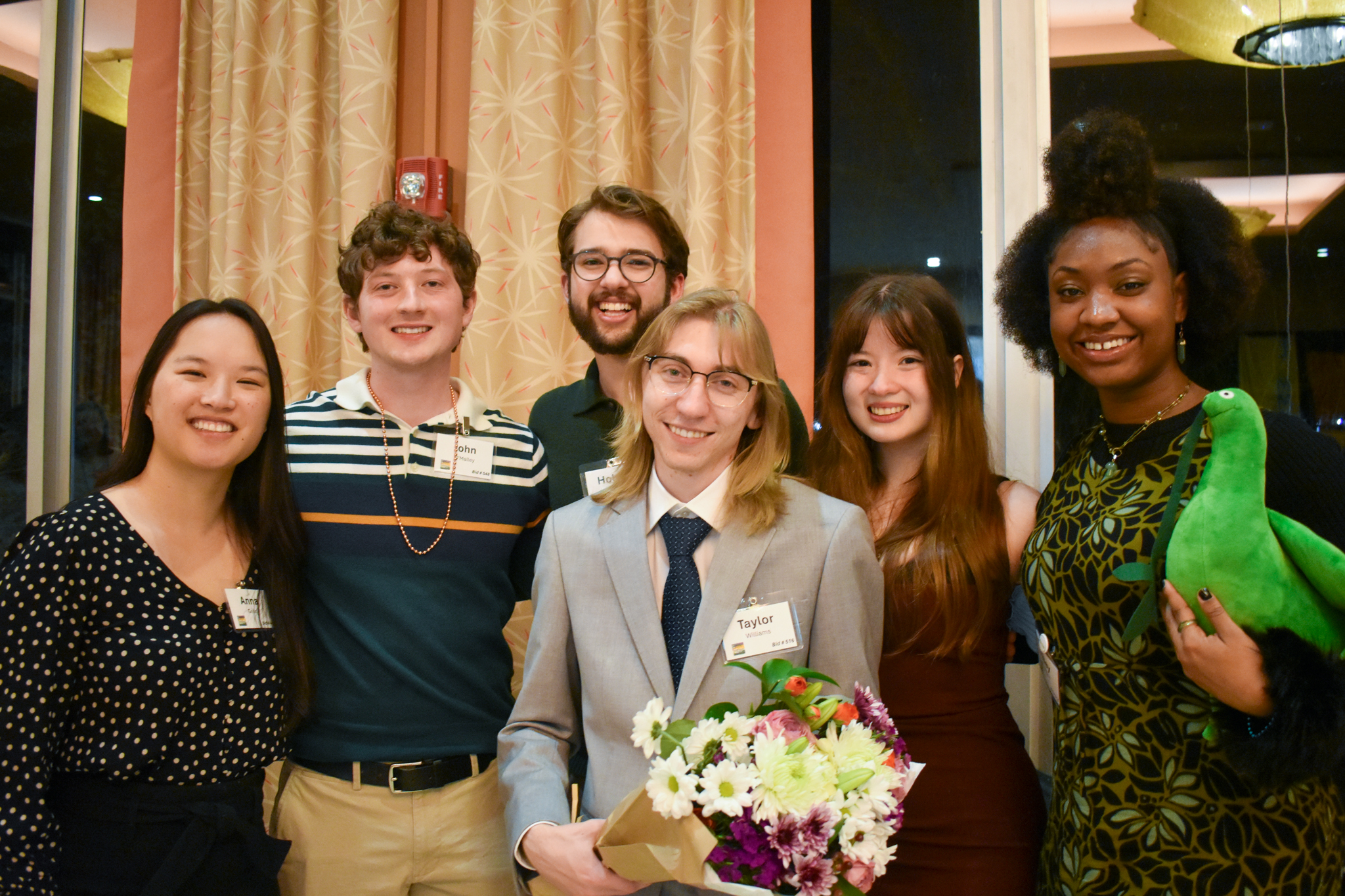
Taylor Williams (he/they), serves as a Day Treatment Volunteer at Community House Mental Health Agency. He lives in the Seattle Cherry Abbey Jesuit Volunteer community. Taylor shared the following at our 2026 Annual Benefit Dinner as he reflects on his time in his JV community and serving with folks in recovery.
It was not by coincidence that I chose to serve in the behavioral health field. My uncle struggled with severe mental illness and substance use disorder, and witnessing his experiences instilled in me a desire to address the cultural and systemic failures that underlay his difficult life. When he died of a fentanyl overdose at the end of 2024, I was devastated. Amidst my grief, a familiar indignation welled up within me, and anguished over a present that appeared intolerable to me, I chose to act. I chose to serve as a Jesuit Volunteer because I wanted to do what I could to contribute to a kinder, gentler future for people like my uncle. In the months I have served at Community House, I have remained fueled by this same desire, but the experiences I have had serving alongside my community have changed me. They have shown me the shape of progress.
Perhaps owing to Western cultural assumptions, our typical understanding of progress traces it across a linear path: it moves forward, it stops, or it regresses. In progressive causes like this one, we often speak in future tense; we strive to build a better future, or a kinder, gentler one, and the underlying assumption is that this future does not yet exist. After my uncle died, I certainly felt this way, but now, over half a year into my term of service, I would challenge that assumption.
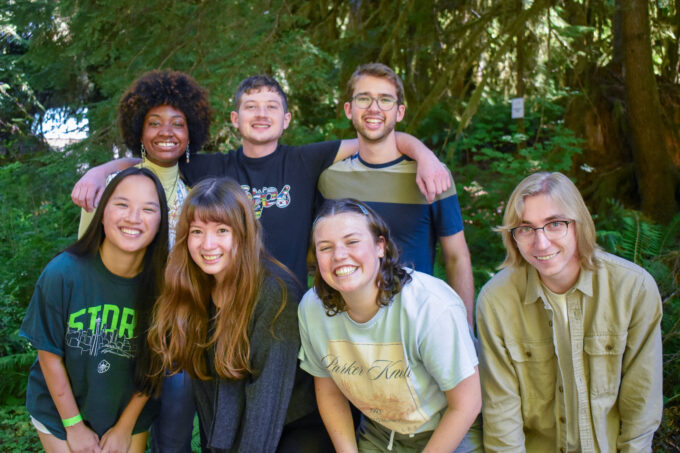
I’ll start by talking a little bit about my community at Cherry Abbey. Former and present JVs can likely relate to how absurd of a concept it is to move to a totally different part of the country and live with a group of complete strangers, and even more absurd than that concept is the reality that it actually works. It is fascinating to build a relationship from scratch with people you also live with because you have no choice but to see each other. Proximity leaves no room for pretense, and one could say the closeness of a relationship can be measured by how often you see each other in pajamas.
I can tell who is walking around the house from the rhythm of their footsteps alone. I know who is opening the door based on how much they struggle to punch in the code (or maybe that’s just Jack). In my own case, tales of my milk consumption have crossed state lines to our wider JV community such that the first thing I heard from a non-SeaTac JV after orientation was, “So I heard you like milk.” I think you really start to know someone when you notice these idiosyncrasies, and you really start to love them when they make you smile. A close friend of mine studied abroad in Almaty, Kazakhstan, and when I described some of this to her in one of our letters, she replied with something interesting: to say “I love you” in Kazakh is “Мен сені жақсы көремін” (Men seni jaqsı köremin); translated literally, this means, “I see you clearly.”
In my service at Community House, I work alongside individuals living with mental illness, and getting to know them personally is essential to support them in their recovery. Initially, this was an intimidating prospect. I am a reserved person by nature, and with dozens of people showing up to our day treatment program every day, I was quite overwhelmed. Furthermore, everyone has a different baseline, and there is significant variation in the manifestation of the psychotic features of their conditions. For example, my very first interaction with a client in day treatment began with them informing me that they were an invincible pro gamer and that the government had tried to nuke them twice, evidently to no avail. I tried to redirect by latching on to one detail and followed up by asking them, “You’re a gamer? What kinds of games do you play?” They smirked, and while miming a mic drop, replied, “All of them.”
I often felt so clueless, and that, because I was clueless, I was failing in some way. I have my clients to thank for snapping me out of that with the consistency of their kindness. Every morning, I can expect to be greeted with a smile and a fist bump. I distinctly remember one specific morning, when, while making a visit to one of the agency’s Standard Supportive Housing buildings, I bumped into a group of day treatment regulars. When they saw me there, their faces lit up with these huge, warm smiles, and almost in unison, they said, “Taylor! What are you doing here?” It was a short interaction, and yet this was one of the most moving things I have ever experienced in my life. That my presence alone could inspire such joy in my community was irrefutable proof that I was doing something right, even if I could not put it into words.
Over time, I learned my clients’ names, their stories, their baseline, their interests, what kind of music they like, and what flavor of jam they prefer on their toast. I listen to their conversations, where they ask each other things like, “Do you ever think your voices are funnier than you are?” I work on the Seattle Times crossword with them. I watch them play cards with my fellow JV, Bridget, and, when she wins, I about keel over laughing after one of them protests, “Hey! That’s abusive! We’re mentally ill!” They are my clients, but they are also my community, and I know they are my neighbors because I know what their laughs sound like.
My supervisor, Lara, once said that it is amazing that we know our clients so well that we can tell that someone is not doing well just from her talking about Tupperware. I think she is right–it is amazing–and the basis for the transformative capacity of our work is actually rather simple. It lies not in doing or saying the right thing, but in striving, no matter how complicated or confusing or absurd it may be, to see our neighbors as they are now, to see them clearly.
Recovery is complicated. For a variety of reasons–trauma, lapses in sobriety, medication changes, and more–people decompensate in their ability to self-regulate their mental illness, and every time, this feels like a heart-breaking setback. Now I wonder, in some absurd way, is it really? Maybe I am mistaken about the shape of recovery, and what appears a regression across a line is, in fact, a digression, a going around, and my job is not to tell them where to go, but to help them along their own way. Maybe the shape of recovery, and progress itself, is a spiral cyclically converging to its center—maybe, in a word, it is revolutionary.
The kinder, gentler future I dreamed of already exists—not everywhere—but it exists. Lately, it has become harder to see, as our leaders promise to restore Eden if only they can remove those they deem its outsiders and destroy those they deem its enemies. “Paradise is whatever we rule over,” they decree, but of course, they are wrong. The promise of paradise is hell. What they fail to see, in their arrogance and cruelty, is that Eden is still here, it exists right now, in the laughter in the kitchen of Cherry Abbey, in the absurd, guileless sea of humanity that meets behind a wall of glass and concrete on 23rd and Jackson, in a sterile room with a hospital bed, where I sit beside my bedridden client who is crying because I brought him a soda from the vending machine down the hall.
It is in this room, right now, but it does not just sit there, inanimate. It is a living thing, a process, like a flame is, sputtering though it may be, and we must make the choice to tend to it, always. As we turn to the future, I ask you to also look around and see your neighbors clearly. Let us not, in our striving toward progress, fail to see what already is. Let us feel not just the shape of progress, but also its rhythm, its gait, and its melody.